What Is the Most Expensive Thing in a Production/Packaging Line?
A Technical Analysis of Cost-Increasing Factors
What is the most expensive element in a production line?
Is it the initial investment cost of the machine?
The price tag of a high-speed packaging system?
Or the energy bill?
The real answer is rarely written on the invoice.
In a production or packaging line, the most expensive factor is inefficiency.
And this inefficiency manifests itself in many forms — from unplanned downtime and low OEE to film waste and incorrect machine selection.
In this article, we examine the key cost-driving factors in a production or packaging line from a technical perspective.
1. Unplanned Downtime: The Quietest Cost
In a high-speed line producing 400–600 packs per minute, every minute represents significant economic value.
However, when the line stops:
- Production output is lost
- Labor costs continue
- Energy consumption persists
- Delivery pressure increases
The main causes of unplanned downtime include:
- Mechanical failures
- Sensor and automation errors
- Film breaks
- Product feeding imbalances
- Operator intervention mistakes
Lines with low MTBF (Mean Time Between Failures) and high MTTR (Mean Time To Repair) generate substantial hidden costs — even if they appear to be operational.
In a production line, the most expensive minute is the one that does not run.
2. Low OEE: The Invisible Performance Loss
OEE (Overall Equipment Effectiveness) reveals the true productivity of a line:
OEE = Availability × Performance × Quality
A line may operate at 90% of its nominal speed.
However, when micro-stoppages, speed losses, and quality defects are taken into account, the actual OEE may drop to 65%.
What does this mean?
- Longer operating hours for the same output
- Additional shifts
- Increased maintenance frequency
- Higher energy consumption
Even a 5% improvement in OEE can significantly impact annual return on investment.
3. Film and Product Waste: Small Ratio, Major Loss
A 2–3% waste rate in a packaging line is often considered “acceptable.”
However, in applications using high-barrier films, laminated materials, or MAP technology, this ratio translates into substantial annual costs.
Key causes of waste include:
- Incorrect sealing jaw pressure and temperature settings
- Film tracking and alignment problems
- Weighing systems losing accuracy
- Lack of proper calibration during format changes
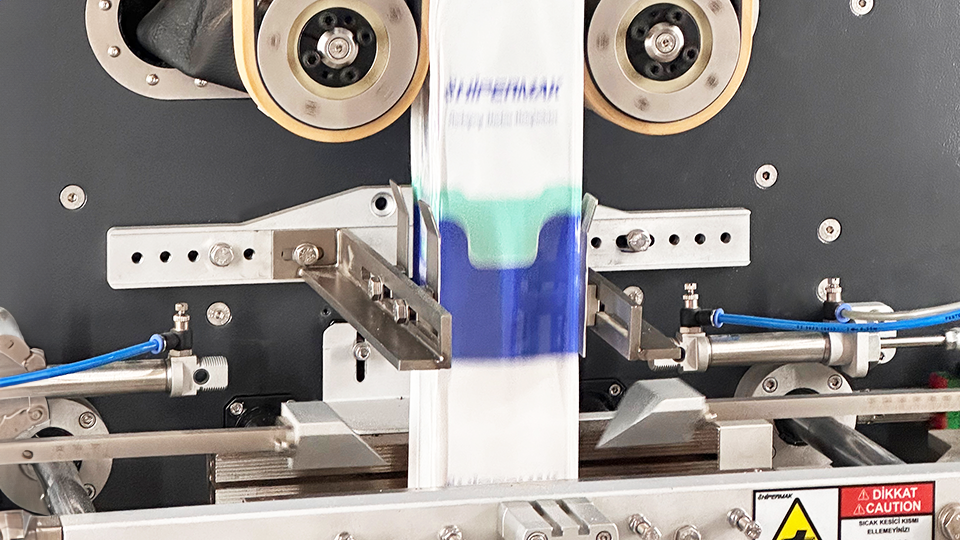
Especially in high-speed VFFS machines, stable jaw control and servo precision directly affect waste levels.
It should not be forgotten:
Waste is not only a material loss — it is a loss of time and capacity.
4. Energy Consumption: A Continuous Expense
Energy costs are among the most consistent expense items in production facilities.
Cost-increasing factors include:
- Old-generation pneumatic systems
- Continuous compressed air leaks
- Inefficient motor technologies
- Non-optimized temperature control systems
Servo-driven, energy-efficient machine designs provide substantial savings, particularly in high-speed lines.
Energy efficiency is no longer just a sustainability issue — it is a competitive advantage.
5. Long Changeover Times
In markets where product variety is increasing, flexibility has become critical.
However:
- Complex mechanical adjustments
- Systems requiring manual intervention
- Operator-dependent calibration
extend changeover times.
The difference between a 45-minute changeover and a 10-minute one can create dramatic effects on annual capacity planning.
Systems designed according to SMED principles reveal the true productivity potential of a line.
6. Incorrect Machine Selection: Short-Term Gain, Long-Term Loss
A low initial investment cost does not always mean a low total cost.
Incorrect decisions may result in:
- Insufficient speed capacity
- Incompatibility with future product variations
- Weak service support
- Spare parts supply issues
Total Cost of Ownership (TCO) should never be evaluated solely based on purchase price.
The right investment must address not only today’s needs but also the next 5–10 years.
The Most Expensive Thing Is Not the Machine — It Is Inefficiency
In a production or packaging line, the most expensive elements are:
- Unplanned downtime
- Low OEE
- Packaging and product waste
- Energy inefficiency
- Poorly designed system architecture
True competitive advantage is not only about high speed, but about stability, continuity, and optimized performance.
If you want to analyze where costs are increasing in your production line and reduce your total cost of ownership, it may be time to evaluate high-performance, energy-efficient system architectures.
At Hipermak, we focus on increasing production efficiency and reducing hidden costs through our high-speed vertical packaging and integrated line solutions.
How efficient is your production line — really?
Let’s analyze it together.